- PHOENIX METRO (623) 939-3329
- TUCSON (520) 200-2958
- PRESCOTT (928) 445-3828

- PHOENIX METRO (623) 939-3329
- TUCSON (520) 200-2958
- PRESCOTT (928) 445-3828
Safe, healthy, comfortable, durable, and energy efficient — that’s what every home should be. We built our company around that belief and named it after it. Home performance is the science of making your entire house work better as a system.
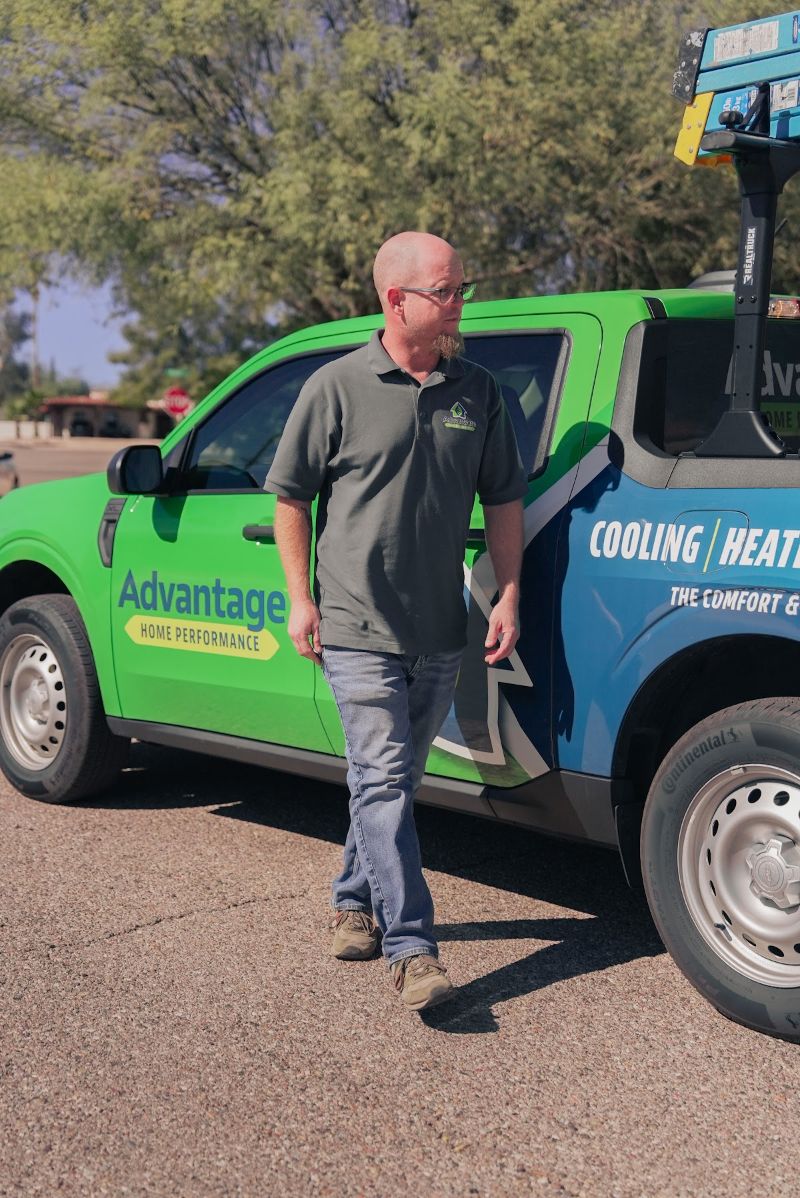
Home performance is both a philosophy and a science based on the premise that homes should be safe, healthy, comfortable, durable, and energy efficient. We based our company name — Advantage Home Performance — on this approach to solving problems and delivering results.
Most contractors treat your house as a collection of separate parts — the AC, the ducts, the insulation, the windows. But in reality, they all interact. A leaky duct system doesn’t just waste energy; it pulls dusty attic air into your living space, strains your equipment, and makes some rooms uncomfortable no matter what the thermostat says.
Home performance looks at the whole picture. We measure what’s actually happening in your house — airflow, pressure, temperatures, insulation effectiveness, duct leakage — and fix the root causes instead of chasing symptoms. The result is a home that’s genuinely more comfortable, healthier to breathe in, and dramatically cheaper to operate.
Most Arizona homes — especially those built before 2000 — have at least one of these issues quietly driving up bills and driving down comfort.
In Arizona homes with ducts in unconditioned attics, duct losses can exceed 30% of total energy use. You’re paying to cool your attic instead of your home.
Settled, compressed, or missing insulation lets heat pour in during summer and escape in winter. Most attics we inspect are performing far below their rated R-value.
Hidden gaps around plumbing penetrations, recessed lights, and top plates let conditioned air escape and bring in dust, allergens, and outside heat.
Bigger isn’t better. An oversized AC short-cycles — blasting cold air then shutting off before it can dehumidify or reach all rooms evenly.
“Some rooms are too hot, others too cold.” This almost always points to airflow imbalances, duct problems, or insulation gaps — not a bad thermostat.
If your energy bills seem too high for the size of your home, the cause is usually a combination of the problems above — each one compounding the others.
Pretty bad. This short case study of a house in Mesa epitomizes just how extreme the problems can be. It’s an educational video that tells a story of fraud, neglect, and ignorance — and the quality of the workmanship is appalling.
Most houses aren’t this extreme, but most homes built before 2000 have significant attic insulation problems that are costing homeowners money every single month.
Instead of guessing, we measure. Every home performance project starts with a detailed assessment so we know exactly where the problems are — and exactly how to fix them.
We calculate the actual heating and cooling load of every room — not a rule-of-thumb estimate. This ensures equipment is properly sized for your specific home, orientation, and insulation levels.
Using calibrated equipment, we pressurize your duct system and measure exactly how much air you’re losing. If the number is too high, we can pinpoint and seal the leaks.
A blower door depressurizes the house to measure total air infiltration. This tells us how “leaky” the building envelope is and where the worst gaps are hiding.
We measure the actual CFM delivered to each room and compare it to the design requirement. If a room isn’t getting enough air, we find out why and correct it.
From diagnosis through repair, we handle every aspect of making your home perform the way it should.
We find and seal the leaks so your conditioned air reaches the rooms it’s meant for — not the attic.
Blown-in insulation, batt replacement, and insulation upgrades to bring your attic up to current energy code standards.
Closed-cell and open-cell spray foam for superior air sealing and insulation in one application — ideal for existing homes.
Targeted sealing of gaps, cracks, and penetrations in the building envelope to stop unwanted air movement and improve indoor air quality.
A comprehensive evaluation of your home’s energy use with a clear report of findings and prioritized recommendations.
Properly sized heating and cooling equipment based on Manual J calculations — not guesswork or rules of thumb.
In this two-minute video, Advantage Home Performance introduces a more proactive and comprehensive way to purchase a new heating and air conditioning system.
By addressing the common problems that plague most homes over 15 years old, homeowners can improve the comfort, efficiency, and indoor air quality of their homes. This short video illustrates exactly what you should expect in both a home assessment and an HVAC estimate.
Our commitment to building science isn’t just talk. Advantage Home Performance has contributed to the industry’s most respected publications.
Home Energy Magazine, Jan/Feb 1996
Journal of Light Construction, August 1993
Journal of Light Construction, April 2003
Qualifying home performance improvements can earn significant rebates through the Efficiency Arizona program for income-eligible Arizona households — one of the most generous home electrification programs in the country. We’ll walk you through exactly what you qualify for before you buy.
Get a thorough, no-pressure assessment from the team that’s been solving home performance problems across Arizona for over 28 years.
Oops! We could not locate your form.